
You’ve finished the course. You can build a to-do app, you understand loops and functions, you’ve even deployed something to the internet. So why does the job search still feel impossible?
Here’s the truth nobody tells you early enough: writing code and being job-ready are two different skill sets. Technical fluency gets you in the door for an interview. But there’s a second layer of skills — quieter, less flashy — that actually gets you hired and keeps you employed once you’re there.
At Enegxi Institute, we’ve watched hundreds of students go from “I can code” to “I got hired,” and the difference almost never comes down to syntax. Here are the five skills that make that gap disappear.
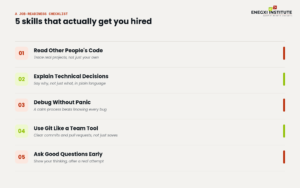
- Reading Other People’s Code
Nobody warns you that most of your job won’t be writing new code it’ll be reading, understanding, and modifying code someone else wrote. Often code with no comments, unfamiliar naming conventions, and decisions made three years ago for reasons lost to time.
If you’ve only ever built projects from a blank file, this is a real gap. Start closing it now: pick an open-source project on GitHub in a language you know, and try to trace how one feature actually works, file to file. It’s uncomfortable at first. That discomfort is the skill being built.
- Explaining Technical Decisions in Plain Language
You will be asked “why did you do it that way?” by an interviewer, a teammate, a manager who doesn’t code, or a confused stakeholder. If your only answer is “because it works,” you’re missing a skill employers actively screen for.
Practice narrating your own projects out loud: what problem you solved, what trade-off you made, why you chose one approach over another. This is exactly what technical interviews test, and it’s a muscle, not a talent it gets stronger the more you use it.
- Debugging Without Panic
Bootcamp exercises are designed to be solvable. Real bugs are not designed at all they just exist, tangled in code you may not have written, with an error message that lies to you about where the actual problem is.
The skill here isn’t knowing every possible bug. It’s having a calm, repeatable process: reproduce the issue, isolate the smallest failing piece, check your assumptions one at a time. Employers aren’t looking for developers who never get stuck they’re looking for developers who don’t fall apart when they do.
- Working With Version Control Like a Team, Not a Backup Tool
Most learners use Git as a save button commit, push, done. But on a real team, Git is a communication tool. Branch names, commit messages, and pull requests are how your teammates understand what you did and why, often without ever talking to you directly.
Before your first job, practice writing commit messages that explain intent (“fix null check on user login” beats “fix bug”), and get comfortable with the pull request workflow creating one, responding to feedback on it, and reviewing someone else’s.
- Asking Good Questions at the Right Time
There’s a myth that senior developers know everything and junior developers should struggle in silence to prove themselves. In practice, the opposite is true: the developers who grow fastest are the ones who ask clear, well-formed questions early after they’ve made a genuine attempt, not instead of one.
A good question shows your thinking: “I tried X, expected Y, got Z instead here’s what I’ve checked so far.” That single habit will save you weeks of stuck time over your first year, and it signals maturity that hiring managers notice immediately.
The Real Takeaway
None of these five skills show up on a certificate. You can’t “finish” them the way you finish a course module. They’re built through repetition, discomfort, and a bit of intentional practice which is exactly why so many technically capable people still struggle to land their first role.
The good news: none of this requires more coding tutorials. It requires treating your learning process like the job itself messy code, real questions, and all.
At Enegxi Institute, our cohorts are built around this exact gap not just teaching you to code, but preparing you for the version of the job that actually exists once you’re hired. Explore our Software Engineering, Frontend & Backend Development, Mobile Development, and Product Management tracks to start building both halves of the skill set.