
Every job listing says the same thing: “1-2 years experience required.” You’re fresh out of school, you didn’t land an internship, and now you’re stuck in the oldest trap in the job market you need experience to get hired, and you need to get hired to get experience.
Here’s what nobody tells you early enough: a traditional internship is just one way to get experience. It’s not the only way, and increasingly, it’s not even the most convincing way. Let’s talk about what actually works when the internship route doesn’t pan out.

Why “No Internship” Doesn’t Mean “No Experience”
An internship is valuable because it proves three things to an employer: you can work on a real problem, you can collaborate with other people, and you can follow through on something over time. That’s it. That’s the whole value proposition.
None of those three things require a company’s permission to prove. You can demonstrate every one of them on your own, starting today, with nothing but a laptop and internet access.
Four Things That Substitute for an Internship
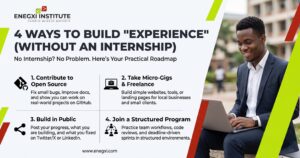
- Contribute to an open-source project. Pick a project on GitHub that’s actively maintained and tagged with “good first issue.” Fix a small bug, improve a piece of documentation, add a test. This single act proves you can read unfamiliar code, follow a team’s contribution process, and collaborate with people you’ve never met the exact muscles an internship is supposed to build.
- Take on real freelance micro-gigs, even small or unpaid ones at first. Build a simple website for a local business, a small tool for a student organization, a landing page for a friend’s side hustle. The pay might be small or nonexistent at the start, the point isn’t the money yet, it’s the paper trail: a real client, a real deadline, a real “this needs to work for someone other than me.”
- Build in public, not in private. Most students build projects and let them die quietly in a folder. Instead, post your progress, what you’re building, what broke, how you fixed it on Twitter/X, LinkedIn, or a dev community. This does two things: it creates a visible trail of consistent work, and it occasionally puts you directly in front of people who hire.
- Join a structured program that simulates real team work. This is the gap self-study alone often can’t close: working inside a team, with code reviews, deadlines, and a real production-style workflow. This is precisely why project-based, mentor-led programs exist they compress the “team experience” problem into months instead of leaving it to chance.
How to Talk About This in an Application
Here’s where most fresh grads undersell themselves: they list these things like hobbies instead of like experience. Compare these two lines:
“Worked on some personal projects in my spare time.”
versus
“Resolved 6 issues on an open-source TypeScript library used by 200+ developers; built and shipped a booking tool for a local business, used weekly by their 3-person team.”
Same underlying work. Completely different signal. Specifics numbers, real users, real outcomes are what separate “I was just messing around” from “I have relevant experience,” even when no company’s name and no internship title are attached to it.
The Real Takeaway
The internship pipeline was never the only door in. It’s the door that happens to be the most visible, the most advertised, and because of that the most competitive. The side doors (open source, freelance work, public building, structured mentorship) are less crowded, and they prove the same things an internship proves, just without needing someone else’s permission to start.
You don’t need a company to hand you your first experience. You need to go create it yourself, document it well, and talk about it with the same confidence you’d have if it came with a corporate logo attached.
At Enegxi Institute, our programs are built around exactly this gap, real team workflows, real projects, and real portfolio-ready outcomes, for the students who didn’t get the internship but still need the experience.